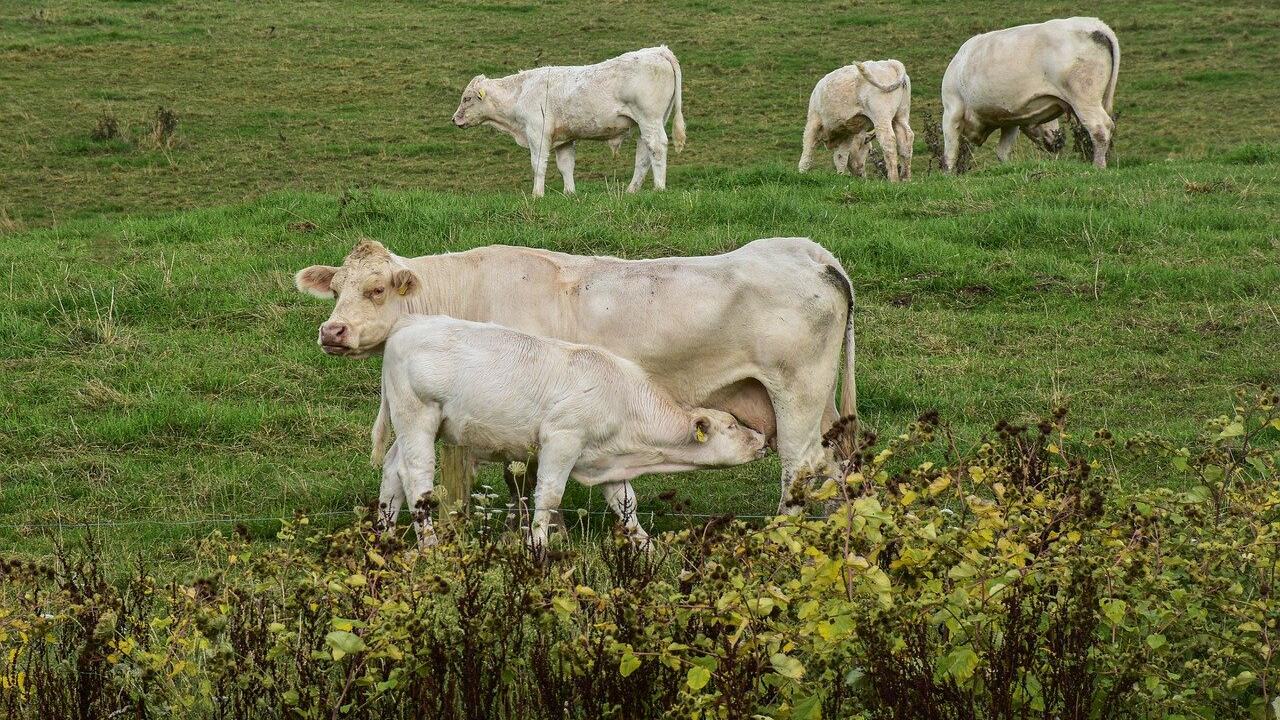
You have a pasture, a few cows and a fence line, and you need to know how many acres per cow the ground can really carry before you buy more cattle.
Quick answer: divide your pasture acres by your cow numbers. NC State Extension calls about 2 acres per cow-calf pair a fair ballpark, with 2.5 acres per cow or more better for pasture recovery. University of Nebraska–Lincoln data show regions from about 1.5 to about 50 grazed acres per beef cow, so your own forage and management set the real figure.
Stocking rate is one step in how to raise grass fed cattle, and it sets the limit for most other grazing decisions. The sections below climb from the quickest check to forage-based calculation and drought planning, so stop at the rung that answers your question.
Start with the division check
The simplest test of stocking rate is arithmetic you can do today. NC State Extension’s advice is to divide your pasture acreage by your cow numbers, and it describes about 2 acres per cow-calf pair as being in the right ballpark. The same publication says 2.5 acres per cow or more is even better when balancing pasture with animals, and that the answer depends greatly on how productive the pasture is and how it is managed.
- Count usable pasture. Include only ground the cattle can actually graze, not buildings, lanes or dense timber.
- Count the cows. Use the number you will carry through the grazing season, not the number you hope to reach.
- Divide acres by cows. The result is your stocking rate in acres per cow.
- Compare it with a ballpark. If you sit well below the extension range for your area, move to the regional and forage checks below before adding cattle.
This check works as a first screen and nothing more. It cannot tell you whether a poor, thin pasture and a lush one deserve the same number, which is why the following sections bring in region and forage.
Regional ranges for acres per cow
Acres per cow vary enormously with climate and forage. A University of Nebraska–Lincoln analysis defines stocking rate as acres per beef cow and treats a lower ratio as greater efficiency. It reports sharp regional differences in grazed acres per beef cow.
| Region or benchmark | Acres per beef cow | Planning use |
|---|---|---|
| Most efficient regions (average) | 1.5 grazed acres | Shows the productive end of the range; not a target for ordinary pasture. |
| North Carolina extension ballpark | About 2 acres per cow-calf pair; 2.5 or more is better for recovery | A reasonable first test in a humid, productive area. |
| Northern Plains | 11 acres | Use as a sanity check for northern rangeland and mixed grass. |
| Southern Plains | 15 acres | Expect to need more ground than the Northern Plains figure. |
| Mountain region | Approximately 50 grazed acres | The highest of any region; rules out comparing mountain ranges with pasture elsewhere. |
Figures come from University of Nebraska–Lincoln BeefWatch and the NC State Extension Wilkes County management article.
These are regional averages for grazed acres, not guarantees for your farm. They answer the question of how many cattle per acre is realistic in your region only roughly: invert the acres-per-cow figure for a cattle-per-acre view, then refine it with your own forage data.
Animal units and cow class
An animal unit is a common yardstick for how much forage different cattle need, so that cows, heifers and calves can be added together on one scale. A herd of mixed classes does not graze like the same number of identical cows.
NC State Extension notes that nutritional demand varies by cow class and that a mature, dry cow sits at the low end of that demand. If your herd carries many animals with higher demand than a dry cow, a stocking rate built on dry cows will leave the pasture short.
From forage yield to herd size
Carrying capacity of pasture is the number of animals its forage production can feed through the grazing season. Forage production is the starting point because, as NC State Extension puts it, the cheapest and highest quality feed is the forage you grow in your pastures.
The calculation runs in a fixed order. Supply your own measured or locally published figures at each step:
- Estimate forage production per acre. Use clipped and weighed samples from your fields or the productivity figures your local extension office provides.
- Keep a share for the plants. Not all growth is available to cattle, because pasture needs leaf area left to recover. NC State’s advice that 2.5 acres per cow or more helps recovery shows why a margin matters.
- Convert the usable forage to animal unit months. An animal unit month is the forage an animal unit eats in a month. Divide the usable forage per acre by that monthly demand.
- Scale up to the field. Multiply animal unit months per acre by your grazed acres, then divide by the number of months you graze.
- Convert animal units to cows. Divide by the animal-unit value of your typical cow, with calves and replacement heifers counted at their own demand.
The result is the herd size your pasture can carry, and dividing acres by that herd gives your acres per cow. Run it with a cautious forage figure first. The species in the sward drive the yield, so see the guide to the best pasture grasses for beef cattle before assuming a higher forage figure than your current stand supports.
Soil survey data and local help
Soil type is a major reason two neighbouring pastures carry different herds. The NRCS Web Soil Survey is the national tool for looking up the soils mapped on your land, and productivity estimates for those soils feed directly into the forage step above.
You do not have to interpret it alone. NC State Extension recommends working with your local Extension Agent or your NRCS/Soil & Water Conservation District Technician to build a grazing plan. Take your field boundaries and a herd count to that meeting, and ask which productivity figures apply to your soils.

Drought, rainfall and destocking
Rainfall decides how much forage grows, so a stocking rate that works in a wet year can fail in a dry one. The University of Nebraska–Lincoln analysis notes that areas with lower stocking rates are likely at more risk to adverse weather conditions, so a figure borrowed from an efficient region needs a margin in a variable climate.
The same publication reported that over 70% of grazed range and pasture was in D1 (moderate drought) or worse at the time it was written, which shows how widely a dry spell can hit at once. When forage falls short, the options are to feed or to reduce numbers. Depopulation means selling cows, heifers, yearlings and calves to fit the available forage.
Buying feed is the costly route. NC State Extension says hay feeding is 2 to 4 times more expensive than feeding from the pasture. Decide your trigger for selling animals before a dry season starts, and read the guidance on winter feeding grass fed cattle if you expect to rely on stored feed.
Checkpoints before changing herd size
Before you buy or sell cattle on the strength of a calculation, confirm each input. A wrong cow count or acreage undoes every later step.
- Accurate head count. Count cows, calves and replacements separately so each class is weighed at its own demand.
- Grazed acres only. Remove ground the herd cannot use before you divide.
- Regional reality check. Compare your result with the ranges in the table; a figure far from your region’s range needs an explanation.
- Recovery margin. If your figure is tighter than 2.5 acres per cow in a productive area, watch for slow pasture recovery.
- Weather plan. Write down how you will respond if forage runs short, whether by hay or by selling animals.
Frequently asked questions
How many cattle per acre is the same as acres per cow?
They are the same measure expressed in opposite directions. Acres per cow is the stocking rate; cattle per acre is its inverse, so a larger acres-per-cow figure means fewer cattle per acre.
Do I count a calf separately from its mother?
NC State Extension’s ballpark of about 2 acres is given per cow-calf pair, so it treats the pair as the grazing unit. For other calf and heifer classes, count their own forage demand in your animal unit calculation.
How much land in the United States is grazed?
The University of Nebraska–Lincoln cites approximately 654 million acres used for livestock grazing in the continental United States, about 35% of land area, based on USDA Economic Research Service data from 2018.